
Dry ice blasting, explained from pellet to plant floor
The physics, the machines, the settings, the safety rules, where it works and where it doesn't, with links to the research behind it.
Dry ice 101
Dry ice is carbon dioxide (CO₂) in solid form. At normal atmospheric pressure it cannot exist as a liquid: it goes straight from solid to gas, a change called sublimation, at −78.5 °C.
That one property is why it cleans so well. A pellet hits a surface, does its work and vanishes as gas. There is no water to dry, no grit to sweep up and no chemical to dispose of. What's left is only the dirt that was removed.
Dry ice is also soft compared with steel, aluminium, chrome or most coatings, so it can strip contamination without cutting into the base material the way sand or grit does.

How dry ice pellets are made
Pellet quality is half the cleaning result. Fresh, dense pellets of the right size hit harder and last longer in the hopper.
CO₂ is captured
Most industrial CO₂ is recovered as a by-product of other processes such as ammonia production, fermentation and refining.
Stored as liquid
It is purified and kept as a pressurised, refrigerated liquid in insulated tanks.
Flashed to snow
Releasing the liquid to atmospheric pressure makes part of it flash into gas and part freeze into CO₂ snow.
Pressed through a die
A pelletizer compresses the snow and extrudes it through a die plate into dense rods, cut into pellets.
Sized for the job
3 mm pellets for heavy deposits; 1.5 mm or shaved micro-particles for delicate surfaces and fine detail.
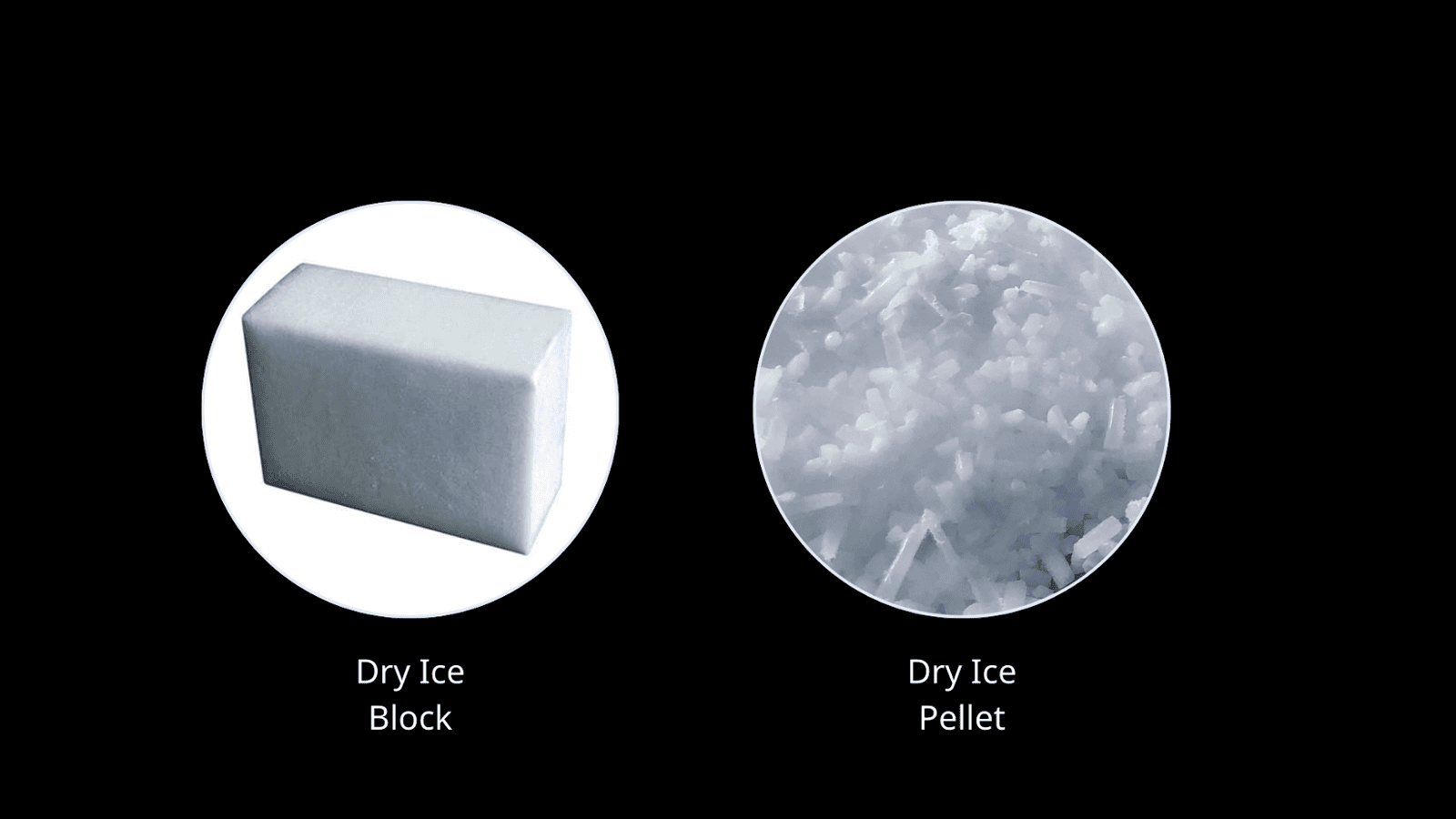
Why fresh pellets matter
Pellets keep subliming while they are stored, even in an insulated box. Over a few days they shrink, round off and stick together. Older ice gives weaker impact and inconsistent feeding.
That's why Kryoblast makes its own pellets on the HT-GB30 pelletizer: the ice reaches your machine fresh, at the right size, when your shutdown needs it.
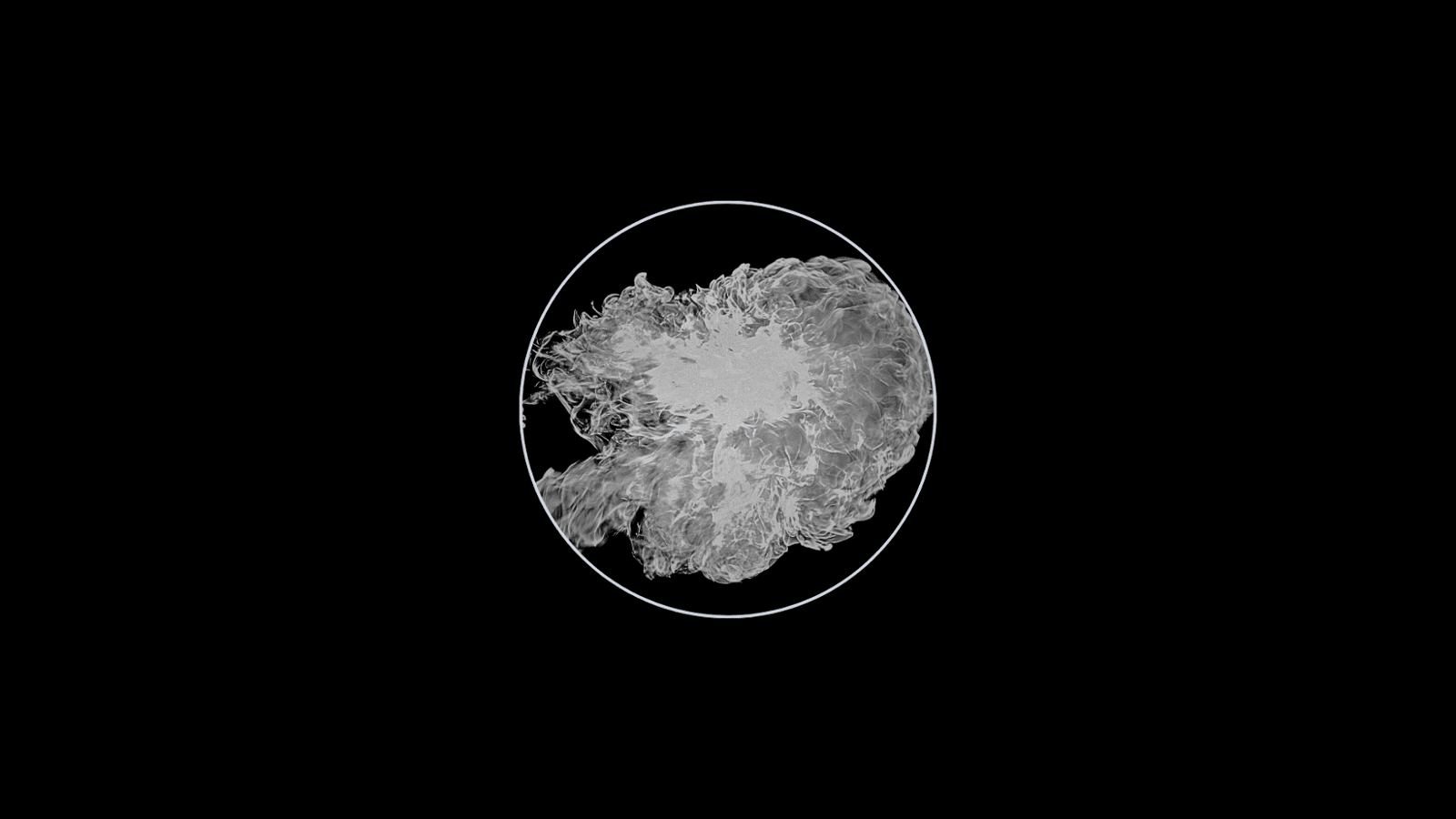
The physics: three effects at once
Press play, or step through each effect. Each stage below is what happens in roughly a few milliseconds at the surface.
Pick a stage, or press Play to watch a pellet clean a contaminated surface.


Inside a dry ice blasting machine
Every blaster does the same basic job: meter pellets out of a hopper into a stream of compressed air and deliver them through a hose to a nozzle. The differences are in how evenly they feed, how much air they need and how well they handle cold and moisture.
Single-hose machines push pellets and air together through one hose for maximum impact. Two-hose (venturi) designs carry ice and air separately and mix them at the gun; they are simpler but usually less powerful.
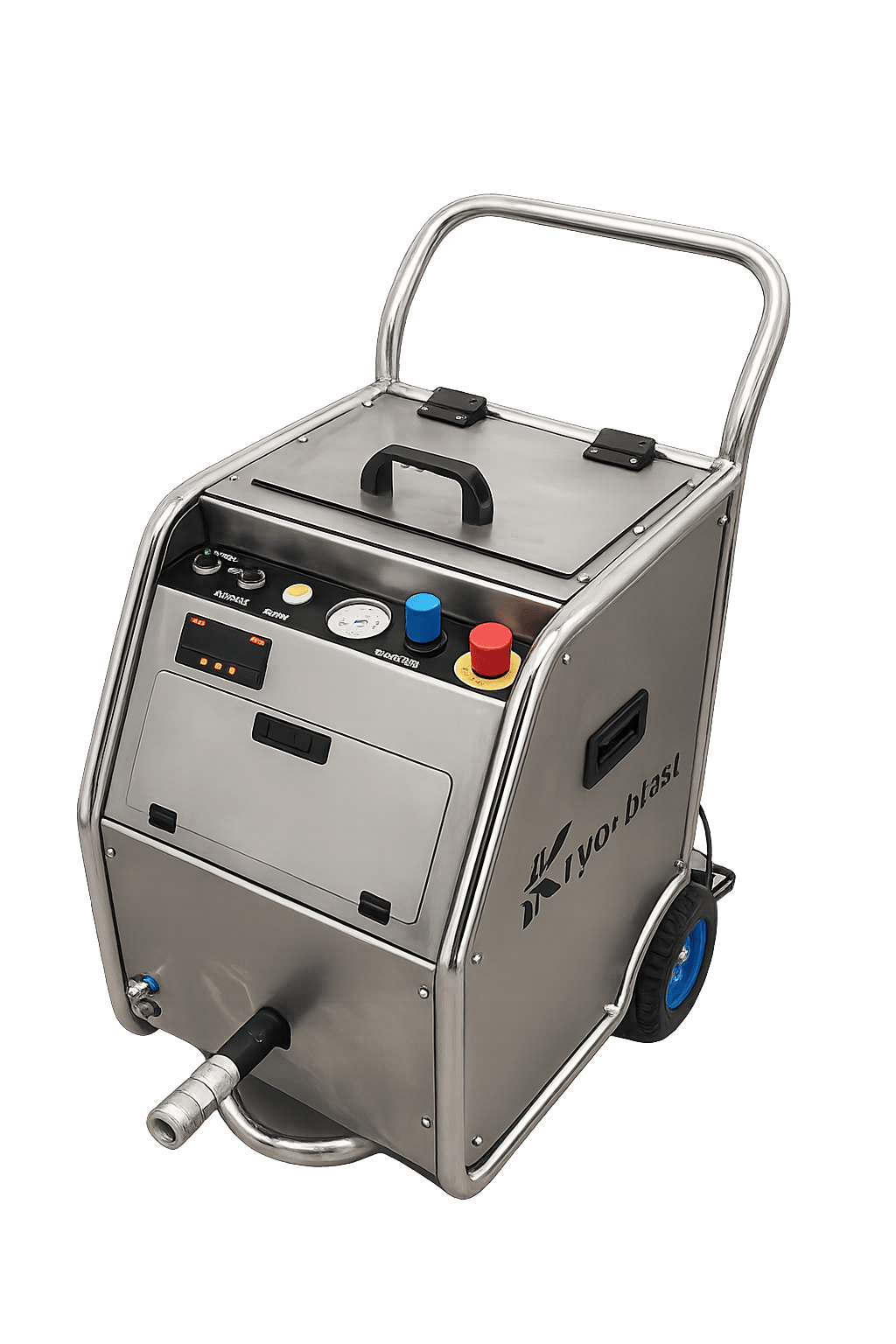
Hopper
Insulated container for pellets. Often vibrated or agitated so ice doesn't bridge and stop flowing.
Feeder
A rotor or airlock that meters a steady dose of pellets into the airstream. Feed rate sets ice consumption.
Pressure regulator
Sets blast pressure. Higher pressure means more aggression, more noise and more air; lower pressure is gentler.
Blast hose
Insulated, static-dissipative hose. Long or kinked hoses waste pressure and can let pellets sublime before they reach the nozzle.
Gun and trigger
Ergonomic gun with a dead-man trigger. Remote triggers start and stop air and ice together.
Nozzles
Flat fan for wide surfaces, round for spot work, angled and extension nozzles for vents, cavities and behind fixtures.
Compressed air
The real power source. It must be dry and oil-free: moisture freezes in the cold hose and causes blockages.
Ice shaver (optional)
Some machines shave block ice into fine particles for delicate cleaning; one study found a pneumatic shaver drive used about 19% of the machine's air (Máša et al., 2014).
The settings that matter
Move the controls to see how each setting trades cleaning power against gentleness, noise and running cost.
Indicative trends to explain the trade-offs, not specifications for any machine. Real settings depend on the contaminant, the surface and your compressor.
Dry ice versus other cleaning methods
| Method | Waste left behind | Abrasive | Near electricals | Dismantling | Drying time | Best for |
|---|---|---|---|---|---|---|
| Dry ice blasting | Only the removed dirt | No | Suitable | Usually not | None | In-place cleaning of moulds, motors, lines |
| Sand / grit blasting | Spent media + dirt | Yes | No | Often | None | Rust and paint stripping on robust steel |
| Soda blasting | Soda residue + dirt | Mild | Limited | Often | Rinse needed | Paint and grease on less delicate parts |
| Pressure washing | Contaminated water | No | No | Often | Hours | Floors, exteriors, robust equipment |
| Chemical solvents | Chemical waste | No | Depends | Usually | Evaporation | Grease and oils on small parts |
| Manual scraping | Dirt | Risk of scratches | Slow | Often | None | Small, occasional jobs |
| Laser cleaning | Fumes, dirt | No | Possible | Sometimes | None | Precision de-coating; high equipment cost |
Electric utilities surveyed by EPRI reported CO₂ blasting took roughly 20% of the time of steam cleaning on electrical equipment, largely because no drying was needed (EPRI, 2002).
Where dry ice blasting works
Industries and the jobs dry ice handles best, with evidence where published research exists.
Plastics and injection moulding
Release agent and gas build-up in moulds and vents, cleaned hot and in the press. Less downtime, fewer rejects.
Rubber and tyre moulds
Vulcanisation residue in vents and textures without damaging engraving. A major research topic for pressure and noise optimisation.
Study: Muckenhaupt et al. 2019 →Food and beverage
Conveyors, ovens, mixers and packaging lines cleaned dry. Removes bacteria comparably to conventional cleaning, but is not a disinfection step on its own.
Study: Witte et al. 2017 →Power and electrical
Motors, generators, switchgear and transformers cleaned in place, reducing outage time.
Report: EPRI 2002 →Automotive manufacturing
Paint-shop fixtures and skids, weld lines, robots and body tooling.
Aerospace and defence
Paint and sealant removal from aluminium panels; studied as a replacement for plastic media blasting.
Studies: ORNL 1995, US Navy →Foundry and die-casting
Sand, binder and carbon deposits on core boxes, dies and tooling.
Printing and packaging
Ink and paper dust on rollers, presses and gluing units without solvents or water.
Fire and smoke restoration
Soot and char removed from structures and machinery after fires, with no water damage.
Facility management and HVAC
Kitchens, exhausts, coils and building services where water and chemicals are a problem.
Vehicle detailing
Engine bays, underbodies and interiors cleaned dry.
Heritage and conservation
Careful, low-pressure cleaning of soot or coatings on historic surfaces, tested case by case.
What dry ice can't do (honestly)
Knowing the limits saves a wasted trial. These come from published studies and user surveys.
It is not a disinfectant
In dairy-equipment tests, bacterial reduction was under 5 log units, so the authors advise against using it as a disinfection step, and recommend blasting away from production areas to avoid spreading bacteria (Witte et al., 2017).
Line of sight only
The jet must reach the surface. Hidden cavities need angled or extension nozzles, or partial dismantling (EPRI, 2002).
Greasy and baked-on layers
Heavy grease and baked epoxies were among the deposits utilities found hard to remove (EPRI, 2002).
Too aggressive can damage
Pellets that are too large or pressure that is too high can harm soft insulation or delicate parts. Start gentle and step up.
It cools the part
Repeated passes lower the substrate temperature, which matters for adhesives, solder joints and electronics (Uhlmann et al., 2025).
It is loud and needs air
Blasting is noisy and needs a large, dry compressed-air supply. Plan compressor capacity before buying.
Safety checklist
Dry ice blasting is safe when done right, but CO₂, cold and noise are real hazards. Tick through the list before every job.
0 of 8 checked
The environmental case
No secondary waste
The blast media disappears. The US Navy cited disposing of more than 100,000 lb of contaminated media a year at one facility when it explored switching to dry ice (NAVFAC NESDI 590).
No wastewater
Nothing to treat or drain, and no water damage to electrics or buildings.
No solvents
Removes solvent purchase, storage, exposure and disposal from the cleaning process.
Recovered CO₂
Blasting ice is typically made from CO₂ captured as a by-product of other industries, rather than produced for its own sake.
Savings calculator
Dry ice blasting pays back mainly through avoided downtime. Enter your own numbers.
Starting values are examples only. Replace them with your plant's figures, or ask us to run the numbers with you.
Glossary
Research library
Peer-reviewed papers, conference proceedings and industry or government reports on dry ice blasting. Links open the original source.
Investigation of the potential of dry ice blasting for cleaning and disinfection in the food production environment
Witte, Bobal, David, Blättler, Schoder, Rossmanith · LWT – Food Science and Technology, 75, 735–741Cleaning comparable to conventional methods on dairy equipment, but under 5 log bacterial reduction, so not recommended as a disinfection step on its own.
Open paper →Effects of a dry-ice process on surface and carcase decontamination in the poultry industry
Manisa Celal Bayar University academic archiveUp to about 3.9 log reduction of total aerobic bacteria on slaughterhouse surfaces; Salmonella inhibited, Listeria still detected on some surfaces.
Open record →Decontaminating food grade surfaces with dry ice blasting (report to the UK Food Standards Agency)
Microchem Bioscience Ltd for the FSA · summary hosted by Cold Jet, an equipment makerReported reductions of 10,000 times or more in Salmonella, E. coli and Listeria on steel, tile and food-grade plastics after defined treatment.
Open summary →Development of a CO₂ snow jet blasting strategy for controlling the thermal influence on the substrate
Uhlmann, Polte, Neuwald, Burgdorf, Coakley · Fraunhofer IPK / TU Berlin · euspen 25th International ConferenceSlower traverse and repeat passes cleaned oil from stainless steel better but cooled the part more; spiral paths beat meander paths.
Open PDF →Influence of dry ice blasting process properties on surface roughness and residual stresses
Procedia CIRPExamines how blasting parameters affect surface roughness and residual stresses on machined and additively manufactured parts.
Open paper →Industrial use of dry ice blasting in surface cleaning
Journal of Cleaner ProductionReview of where and how dry ice blasting is applied for industrial surface cleaning.
Open paper →Efficient and Sustainable Cleaning: A Comparative Analysis of Cryogenic Technology
Vega-Bosch, Santamarina-Campos, Osete-Cortina, Sánchez-Pons, Bosch-Roig · Applied Sciences 14(15), 6591Scored 19 dry ice blasting machines from 8 manufacturers on size, weight, noise, tank capacity and CO₂ consumption.
Open paper →CO₂ Blast Cleaning Process (Report 1006617)
Electric Power Research Institute (EPRI)Primer for utilities on cleaning motors, generators, transformers and switchgear in place; about 20% of steam-cleaning time; notes limits on grease and baked epoxies.
Open report →An Experimental and Numerical Procedure for Energetic and Acoustic Optimization of Dry-Ice Blasting Processes
Muckenhaupt, Zitzmann, Rudek, Russ · Chemical Engineering Transactions, 74, 967–972Tyre-mould cleaning: 8 to 2 bar cut energy and noise but dropped cleaning to about 25%; silencers gave about 9–10 dB(A) reduction.
Open PDF →Decrease in Consumption of Compressed Air in Dry Ice Blasting Machine
Máša, Kuba, Petrilák, Lokaj · Chemical Engineering Transactions, 39, 805–810A pneumatic ice-shaver drive used about 19% of the machine's compressed air; an electric drive cut process energy by about 17.8%.
Open PDF →A centrifuge CO₂ pellet cleaning system
Foster, Fisher, Nelson, Schechter · Oak Ridge National Laboratory · NASA Aerospace Environmental Technology ConferenceTurbine-driven pellet accelerator for stripping military coatings from aluminium panels, more than ten times as efficient as compressed-air blasting.
Open record →Dry Ice Paint Removal and Cleaning (NESDI Project 590)
US Navy · NAVFAC Engineering and Expeditionary Warfare CenterPlanned evaluation of dry ice to replace plastic media blasting at Fleet Readiness Centers, driven by over 100,000 lb of media waste a year.
Open fact sheet →Hybrid Dry-Ice Blasting Laser Processing: Nd-YAG-Laser-assisted Dry-Ice Blasting for De-Coating
Uhlmann, Hollan, El Mernissi · Strojniški vestnik – Journal of Mechanical Engineering, 52(7–8), 458–462Adding laser heating to dry ice blasting raised coating removal rate by up to 49%.
Open paper →An experimental investigation on the safety performance of dry ice blasting technology
Nuclear Engineering and TechnologyExperimental study of the safety performance of dry ice blasting.
Open paper →Dry Ice Blasting: an overview of research topics
ScienceDirect Topics (Elsevier)Collected excerpts from engineering books and journals on dry ice blasting.
Open overview →Summaries are short paraphrases for orientation; read the original for full methods and results. Some publishers require a subscription for full text.
Frequently asked questions
Will dry ice damage my mould or machine?
Not when set correctly. Dry ice is softer than steel and most coatings, so it removes deposits without cutting into the surface. Start with smaller pellets and lower pressure on delicate parts.
Can I clean while the equipment is hot or running?
Moulds and ovens are often cleaned hot, which saves cool-down time. Live electrical cleaning is possible only under your plant's permit and safety procedures.
How much compressed air do I need?
It depends on the machine and nozzle. Dry, oil-free air in sufficient volume matters more than peak pressure. We size this with you before delivery.
How much dry ice will I use?
It depends on feed rate, pellet size and how long you blast. Use the calculator above with your own figures, or ask us for a trial to measure it on your job.
Does it kill bacteria?
It removes contamination, including bacteria, as well as conventional cleaning, but research does not support using it as a stand-alone disinfection step. Follow it with your normal sanitation.
Is it safe for operators?
Yes, with ventilation, hearing and eye protection, insulated gloves and correct handling. See the safety checklist above.
Should I buy a machine or hire a service?
Frequent cleaning (weekly or more) usually favours owning a machine. Occasional shutdowns or one-off jobs often favour our cleaning service.
Try it on your own part
The fastest way to know if dry ice works for your contamination is a live trial. We bring the machine and fresh ice.